
Used boat check at a glance
- in the hull identification number (EU)
- 5 items [1]
- service interval Mercury 15/20 EFI, whichever comes first
- 100 h / 1 year [2]
- full-throttle range Mercury 15/20 EFI
- 5,700 to 6,200 rpm [2]
- water a GRP hull can absorb
- up to approx. 2% [4]
- shortest period EU states may allow for second-hand goods
- min. 1 year [5]
The expensive faults on a used boat are rarely where you look first. Cushions and a bimini can be replaced. A wet transom, water in the gearcase or a boat without proof of ownership cost a lot of money or make the purchase worthless. The Tasmanian maritime authority MAST therefore advises: if you are not sure what you are looking at, bring someone with the right knowledge to inspect the boat [3].
Used boat buying checklist: what to check, in which order?
Check what ends the deal first, and only then what lowers the price. That way you do not travel to boats whose papers are wrong.
-
Check the advert and the papers
Before you travel, ask for photos of the hull identification number, the builder's plate, the engine serial number and the proof of ownership.
-
Inspection ashore
Check the hull outside and inside, the transom, the engine with the cowling off and the trailer. Bring the checklist below.
-
Sea trial
Cold start, water pump indicator stream, forward and reverse gear, full-throttle rpm and steering.
-
Negotiate the price
Set the faults you found and their repair cost against the price, not your gut feeling.
-
Contract and handover
A written contract with the hull identification number, engine serial number, the accessories included and the assurance that the boat is free of third-party rights. A handover record with an equipment list. Take all documents at handover.
What papers should come with a used boat?
Ownership. The seller should prove that the boat is theirs, for example with the previous sales contract or the invoice. If the boat belongs to a bank, a leasing company or an estate, clear this up before you pay any deposit.
Hull identification number and builder’s plate. The EU Recreational Craft Directive requires every watercraft to carry an identification number. It contains the manufacturer’s country code and code, a unique serial number, the month and year of production and the model year [1]. Separately, the boat carries a plate with the manufacturer, the CE marking, the design category, the maximum recommended load and the number of persons [1]. Compare both with the advert and the contract. If the year in the number does not match the stated year of build, ask why.
Owner’s manual. Every product under the directive comes with an owner’s manual that covers set-up and maintenance, among other things [1]. Without it you lack the basis for load, engine power and care.
Engine serial number. Mercury puts the serial number on a decal on the outboard, together with the power in hp and kW and the year of manufacture as a letter code [2]. The number belongs in the sales contract.
Registration. Whether a boat needs a registration or a number depends on the rules of the country where you will use it. Ask the seller for any registration documents and check the rules with the local authority before you buy.
Checking the hull: GRP, aluminium, HDPE
The hull is the most expensive part to fix. What to look for depends on the material.
GRP (fibreglass). MAST lists delamination, rot in the core material and fractures in the glass laminate as typical damage [3]. The transom often has a timber core, and trapped water can rot it. MAST advises removing engine mounting bolts or drain plugs to inspect the timber [3]. Stress fractures show up at thwart connections, along the keel or chines and at the transom gussets [3].
Osmosis on GRP. A GRP hull can absorb up to about 2% water [4]. Over time blisters can form; the fluid inside smells of vinegar and has a greasy texture [4]. Many boats are used for years in this condition, because at first there is very little loss of strength [4]. A diagnosis combines a visual check with a moisture meter; MAST stresses that a meter reading alone is not a diagnosis [4]. It still matters for the price, because a repair is a big job.
Aluminium. Look for electrolysis, corrosion caused by dissimilar metals, which can eventually create holes. Check fastenings, the areas resting on trailer rollers or skids, and the bilge [3]. Also look for fractured welds, for example at frame connections, along the keel and at the transom brackets [3].
HDPE (polyethylene). Osmosis develops in the resin and glass laminate of a GRP hull [4]. An HDPE hull has neither gelcoat nor laminate. Check for deep gouges, deformation and earlier weld repairs. What the material can do is explained in Buying an HDPE boat in Germany.
Checking the engine: service book, cowling off, test run
First ask when the engine was last serviced [3]. Mercury’s manual includes a maintenance log with date, work done and engine hours, and asks owners to keep all work orders and receipts [2]. On the 15/20 EFI FourStroke, maintenance is due every 100 hours of use or once a year, whichever comes first [2]. An engine with few hours but no annual service is therefore not a bargain.
Take off the cowling, check the oil level and look for leaks and gasket problems [3]. With the engine running, water must spray from the water pump indicator; if there is no spray, Mercury says to inspect the water intake on the gear housing [2].
On the sea trial, the engine speed at full throttle matters. The Mercury 15/20 EFI should reach 5,700 to 6,200 rpm [2]. Clearly below that, the propeller does not fit, the boat is overloaded or the engine has a problem. What else slows a boat down is covered in How fast is a 15 hp boat?.
Trailer and equipment
Check the whole trailer, from the winch strap to the rear: rust, wheel bearings and brakes [3]. Whether your car may tow the rig is explained in Boat trailer: licence and towing capacity.
Safety gear sold with the boat may be old or out of date [3]. Check the use-by date on flares and whether inflatable life jackets have been serviced [3]. The skipper, not the boat, is responsible for the equipment on board and for wearing life jackets.
Surveyor: when is one worth it?
If you cannot judge the hull or engine yourself, have the boat inspected by someone with the right knowledge; MAST advises the same [3]. A surveyor can measure and interpret moisture in the hull, because according to MAST a single meter reading is not yet a diagnosis [4]. Agree with the seller beforehand that you can see the boat out of the water for the inspection.
Checklist for the viewing
Checklist
Used motorboat: viewing and sea trial
Tick off on site. Every open point is a question for the seller or an item for the price negotiation.
Liability: dealer or private seller?
Directive (EU) 2019/771 makes a seller who sells to a consumer liable for any lack of conformity that becomes apparent within two years of delivery [5]. For second-hand goods, member states may allow seller and consumer to agree on a shorter period, but not less than one year [5]. Whether and how a country uses this option is set by its national law. The rule describes the seller’s liability towards a consumer; read the contract closely, especially when you buy from a private person. This section is not legal advice; for your case, ask a professional.
Common mistakes when buying a used boat
- Buying without a sea trial. Engine, gears and steering only show their condition under load.
- Trusting hours without a service book. Few hours mean little if the annual service is missing [2].
- Only looking at the outside of the hull. Moisture in the transom or frame cores only shows from inside [3].
- Forgetting the trailer. Wheel bearings, brakes and rust on the trailer cost extra [3].
- Paying a deposit before the paper check. Ownership and identification number first, money second.
Used or new: where the SeaStorm fits
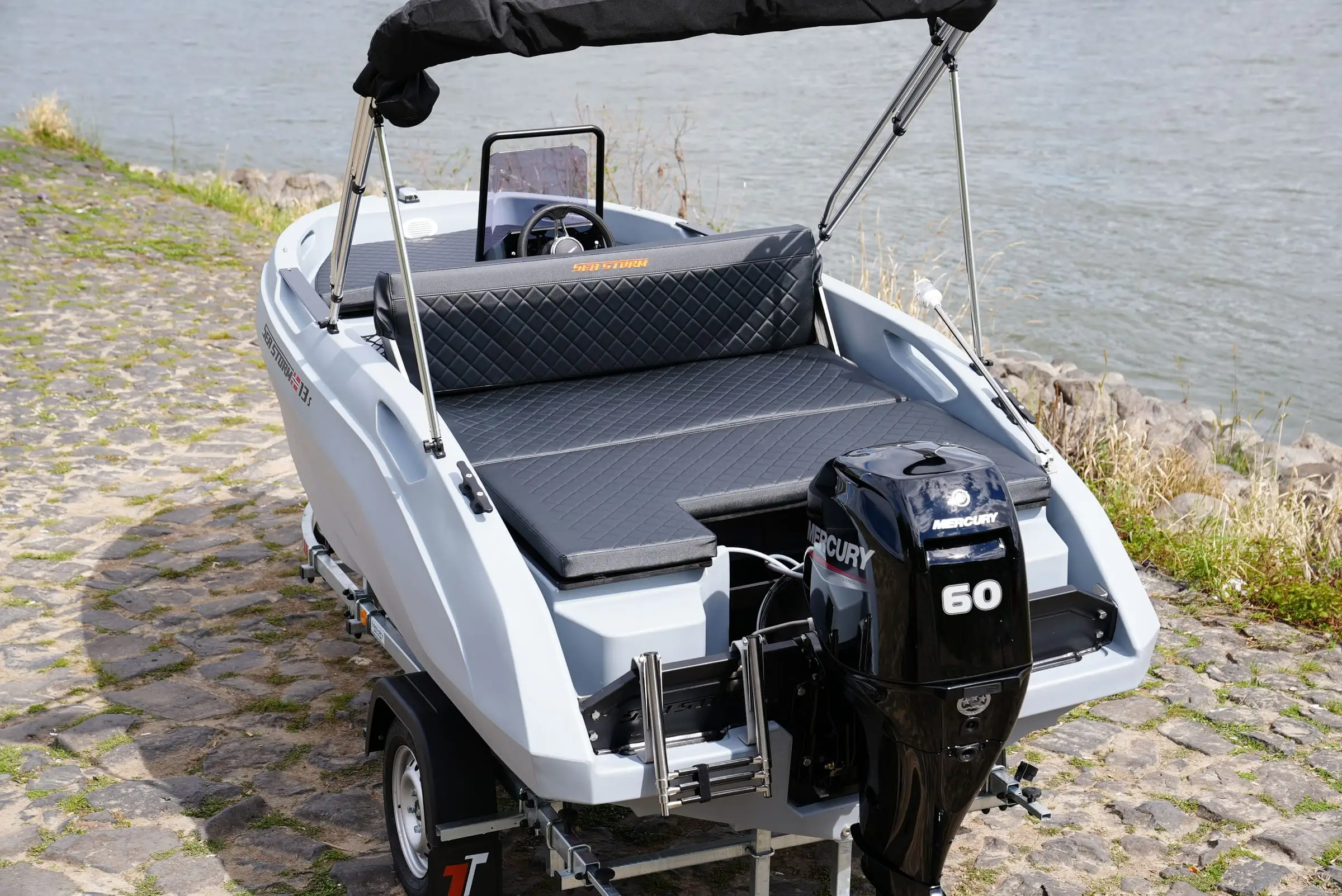
A new boat spares you the questions about history and maintenance, but it costs more. The SeaStorm 12 is available new from €12,499 with a fitted Mercury outboard. Its HDPE hull has no gelcoat and no laminate in which osmosis can develop. Delivery, handover and the cost to your door are on the page Buy a SeaStorm with delivery.
What Nautigo can offer at short notice is listed on the page of boats available now. If a used offer is among them, the same checklist applies: ask about engine hours, maintenance and use.