
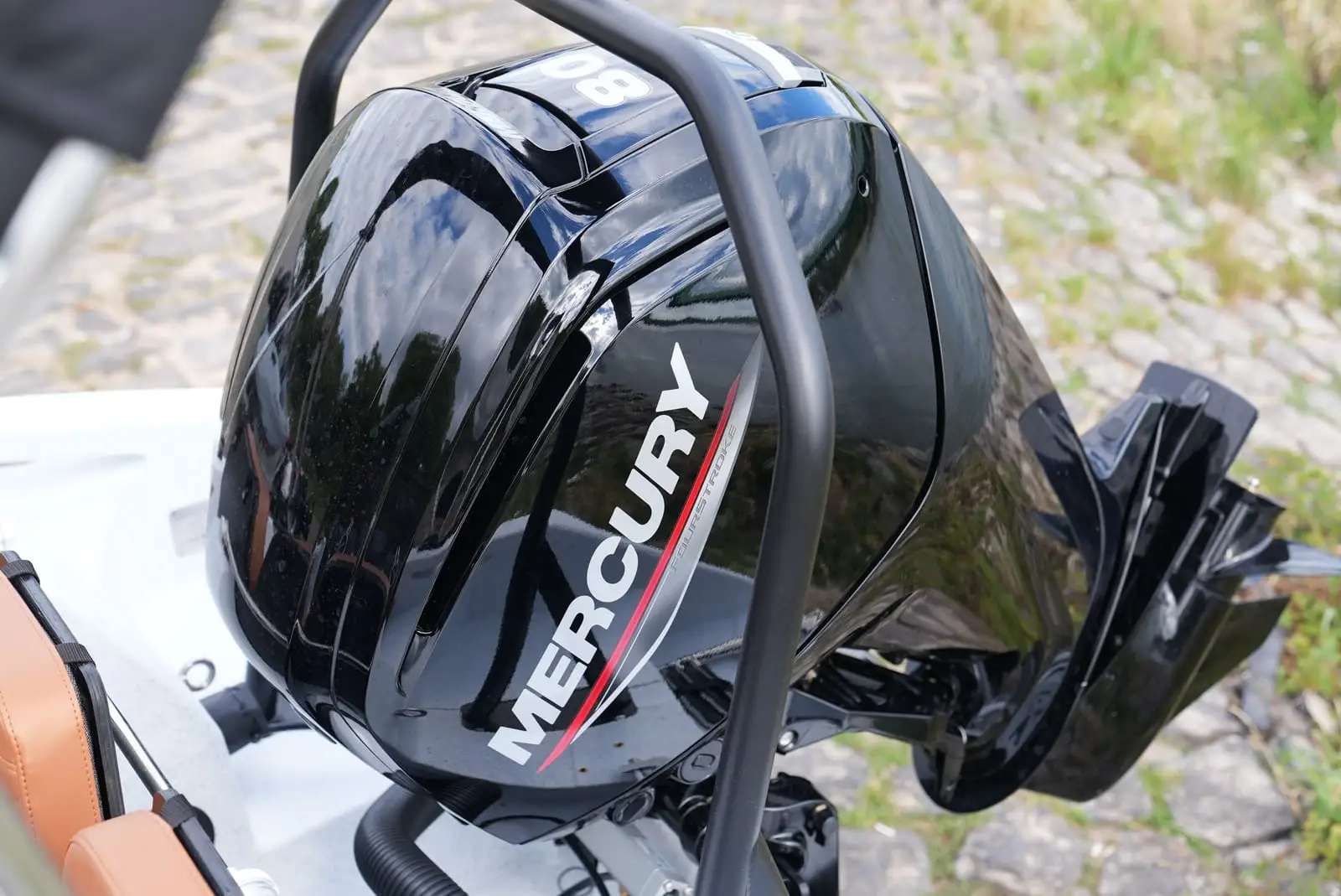
Maintenance schedule at a glance (Mercury 15/20 EFI FourStroke)
This guide follows the maintenance schedule in the manual for the Mercury 15/20 EFI FourStroke [1]. Other engines and model years may differ. The manual of your own engine always takes precedence.
How often should an outboard be serviced?
Mercury divides maintenance into five points in time: before each use, after each use, every 100 hours or yearly, every 300 hours or three years, and before storage [1].
| When | What | Who |
|---|---|---|
| Before each use | check oil level, lanyard stop switch, engine mounting, fuel system, steering, propeller | owner [1] |
| After each use in salt or polluted water | flush the cooling system with fresh water, wash off salt | owner [1] |
| Every 100 hours or yearly | oil, oil filter, gear lubricant, filter, anodes, battery, lubrication, dealer checks | owner and dealer [1] |
| Every 300 hours or 3 years | replace spark plugs and impeller, inspect timing belt and wiring | mostly dealer [1] |
| Before storage | stabilise fuel, fog the cylinders, change engine oil and gear lubricant | owner or dealer [1] |
The annual interval applies even with little use. If you run the engine 30 hours a season, it is still serviced once a year. The German boating magazine YACHT likewise recommends a short annual service for four-strokes that log only a few hours in a season [2].
What does the annual service include?
The list below follows the section “Every 100 hours of use or once yearly” in the manual [1]. Items marked “(dealer)” are listed by Mercury as dealer service.
Checklist
Annual service: every 100 hours or once a year
Based on the Mercury manual for the 15/20 EFI FourStroke. For other engines, compare with your own maintenance schedule.
Mercury offers oil change kits containing a filter, oil and the other parts needed; they are available for models from 15 to 150 hp [1]. The 15/20 EFI holds 1.0 litre of engine oil and about 460 ml of gear lubricant [1].
What is added at 300 hours?
Every 300 operating hours or three years, the 15/20 EFI FourStroke needs further work [1]:
- replace the spark plugs,
- replace the water pump impeller (dealer),
- inspect the timing belt (dealer),
- check wiring and connectors (dealer),
- lubricate and adjust throttle and shift cables, grease all lubrication points, check power trim fluid.
The impeller is replaced sooner if the engine overheats or water pressure drops [1]. For small dinghy outboards, YACHT advises replacing the impeller every 50 operating hours or at least once a year [2]. The difference shows why a generic schedule from the internet does not replace the manual.
After the trip: flushing the engine
After each use in salt, polluted or muddy water, flush the cooling passages with fresh water. Otherwise deposits build up and clog them [1]. This is how Mercury describes flushing via the flush fitting:
-
Remove the propeller
First shift to neutral and pull the lanyard stop switch so the engine cannot start.
-
Connect the hose
Remove the plug from the flush fitting, attach a water hose and turn the water on to half of maximum flow.
-
Run the engine at idle
Start in neutral and do not exceed idle speed. The engine must run so the thermostat opens.
-
Flush for 3 to 5 minutes
Watch for a steady stream from the water pump indicator hole and keep an eye on the water supply throughout.
-
Finish
Stop the engine, turn off the water, remove the hose, refit the plug and the propeller.
Mercury also recommends washing off salt deposits and flushing the propeller exhaust outlet with fresh water. If the boat stays in the water, tilt the engine up when not in use, except in freezing temperatures, so the gearcase is out of the water [1].
Never run the engine without cooling water, not even briefly as a test after servicing. Without sufficient cooling water, the engine, the water pump and other components overheat and are damaged [1].
Warning signs to look for
Changing the gear lubricant shows how the drive is doing. The Mercury manual lists the signs [1]:
- White or cream-coloured lubricant indicates water in the gearcase. Seals and O-rings then need inspecting.
- Exception at the first change: the lubricant can look creamy because assembly lubricant and gear lubricant have mixed. That alone does not mean water.
- Fine metal powder is normal wear. Larger particles or a large amount of powder mean the gearcase must be taken apart and inspected.
- A weak indicator stream or overheating points to the impeller [2].
Laying up the engine for winter
Mercury calls for storage preparation when the engine will stand for two months or longer. The aim is to protect it from rust, corrosion and damage from trapped water freezing [1]:
- Add stabiliser to the fuel. If the petrol contains alcohol, drain as much of it as possible from tank, fuel line and engine.
- Run the engine with cooling water for 15 minutes so stabilised fuel fills the system.
- Remove the spark plugs, add about 30 ml of engine oil or storage spray to each cylinder, turn the flywheel by hand, refit the plugs.
- Change the engine oil, drain and refill the gear lubricant. The new gear oil is pressed in at the drain screw until it comes out of the vent screw [3].
- Spray external metal parts with corrosion protection, leaving out the anodes.
On gear oil, YACHT advises: depending on hours run, new oil is due every one to two years, and every year if in doubt [3]. How to prepare the hull for winter is covered in HDPE boat care and winterising.
Do it yourself or use a workshop?
During the warranty period, service work should stay with an authorised dealer. After that, many owners can carry out simple maintenance on small four-strokes up to about 15 hp themselves [2]. YACHT counts milky gear oil among the findings that belong in the workshop [2].
The Mercury manual helps you split the work: it describes oil changes, filters, anodes and flushing for the owner. It marks thermostat, timing belt, impeller, wiring and the mounting torque as dealer service [1]. Mercury also states that the owner must have routine maintenance performed to keep the engine within its certified emission levels [1]. Record every service with date and engine hours.
What does maintenance cost?
We do not quote a flat rate, because hourly rates and parts prices vary by workshop and country. The bill is made up of three parts:
- Parts and fluids: engine oil, oil filter, gear lubricant and, where needed, fuel filter, anodes and spark plugs.
- Labour: the dealer items of the annual service and the 300-hour work (impeller, timing belt) make the difference.
- Interval: the service at 300 hours or three years covers considerably more items than the annual service [1].
Ask which items from the maintenance schedule a quote includes. Only then can you compare two offers.
Maintenance on a SeaStorm
Every SeaStorm is delivered with a fitted Mercury outboard (SeaStorm 17 with 70 hp: Yamaha), pre-delivery inspection (PDI) and warranty. The engine follows the maintenance schedule in its manual. The HDPE hull has no gelcoat to look after; what it needs over the year is set out in the overview of the HDPE motorboat.
Which engine size suits your use is explained in How much horsepower does my boat need?. The SeaStorm 17 is the largest model and is offered with Mercury FourStroke engines from 15 PS (metric horsepower).