
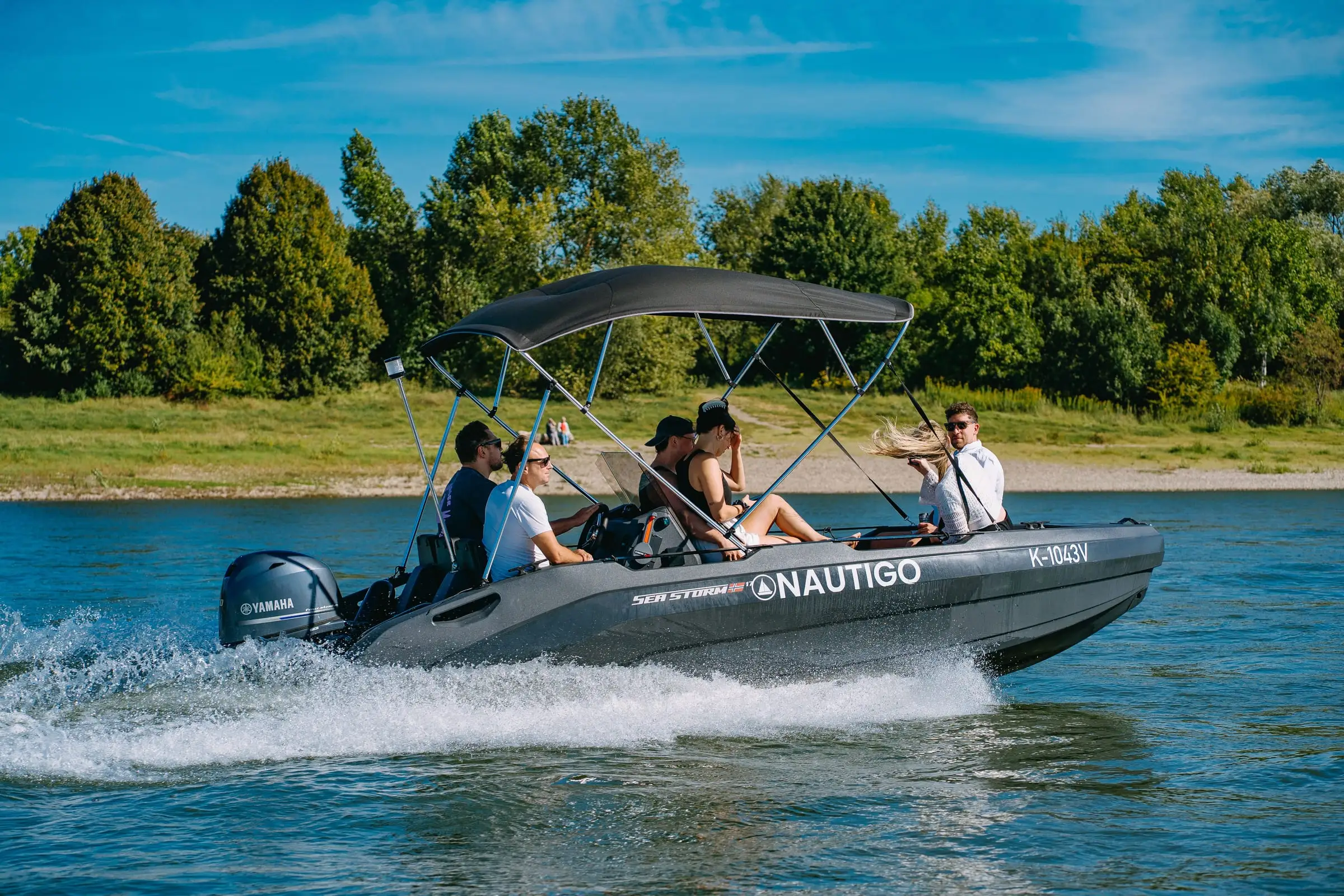
Engine power at a glance
The question “how much horsepower does my boat need?” has an upper limit and a requirement. The builder sets the limit. You set the requirement: through the weight you carry and what you plan to do on the water.
SeaStorm engines are quoted in metric horsepower (PS). One metric hp is slightly less than one US hp [6].
Where is your boat’s maximum horsepower stated?
Under the EU Recreational Craft Directive, the builder must ensure satisfactory handling with the most powerful engine the boat is designed for. The maximum rated engine power must be declared in the owner’s manual [1].
The builder’s plate on the boat does not have to show this figure. It must show the builder, the CE marking, the design category, the maximum recommended load and the number of persons [1]. If the power is not on the plate, check the manual or ask the builder.
Mercury writes in its engine manual that most boats carry a required capacity plate with the maximum power and load; the example shown is the US Coast Guard plate with “Maximum Horsepower” [4]. Mercury also warns that overpowering can affect boat control and flotation or break the transom [4].
Rule of thumb: how much horsepower can a boat take by length and width?
The United States has a formula in law. It applies to monohull outboard boats under 20 feet (6.10 m), not to sailboats, canoes, kayaks or inflatable boats [3]. The calculation under 33 CFR § 183.53 [2]:
- Factor F = boat length × maximum transom width, both in feet (1 ft = 0.3048 m [6]).
- Up to F = 52, a table gives the capacity, from 3 to 15 hp.
- Above F = 52.5, the formula depends on steering and transom height. The result may be raised to the next multiple of 5.
| Boat (F above 52.5) | Maximum in hp | Example 4.50 m × 1.80 m (F ≈ 87) |
|---|---|---|
| Remote steering and transom at least 20 inches high | 2 × F − 90 | 85 hp |
| Tiller steering or lower transom | 0.8 × F − 25 | 45 hp |
| same, flat bottom with hard chine | 0.5 × F − 15 | 30 hp |
The table shows that the same boat can take almost twice the power with remote steering as with a tiller [2]. A small boat of 3.00 m × 1.30 m comes to F ≈ 42 and, from the table, 7.5 hp, or 5 hp with a flat bottom [2].
Which power class suits your use?
Within the maximum rating, the choice is yours. The quiz asks about use, people, waters and your priority and suggests a power class. It can also conclude that a different boat fits better than a bigger engine.
Decision helper
Which power class suits you?
Four questions, one direction. The upper limit is always the maximum rating in the owner's manual.
Possible results
- Look at a different boat: What you need is beyond what the boat is built for. More people than on the plate are not intended, and neither is more power than the maximum rating. A larger boat with a higher load and a suitable design category solves the problem; a bigger engine does not.
- Lower power class: For relaxed boating with little weight, the lower end of the permitted range is enough. It saves purchase price and weight at the stern. An example from the catalogue: the SeaStorm 12 (3.66 m) does about 30 km/h with 15 hp.
- Middle power class: With several people on board you need reserve: extra passengers cost rpm. Size the engine for the full boat, not for solo trips. In the catalogue, the SeaStorm 13s ranges from 15 to 60 hp.
- Upper power class, up to the maximum rating: Watersports and a full crew need reserve when accelerating. A skier in tow costs rpm, and Mercury recommends a lower pitch propeller for it. The boat's maximum rating remains the limit. In the catalogue, the SeaStorm 17 goes up to 80 hp.
Best match
Look at a different boat
What you need is beyond what the boat is built for. More people than on the plate are not intended, and neither is more power than the maximum rating. A larger boat with a higher load and a suitable design category solves the problem; a bigger engine does not.
Best match
Lower power class
For relaxed boating with little weight, the lower end of the permitted range is enough. It saves purchase price and weight at the stern. An example from the catalogue: the SeaStorm 12 (3.66 m) does about 30 km/h with 15 hp.
Best match
Middle power class
With several people on board you need reserve: extra passengers cost rpm. Size the engine for the full boat, not for solo trips. In the catalogue, the SeaStorm 13s ranges from 15 to 60 hp.
Best match
Upper power class, up to the maximum rating
Watersports and a full crew need reserve when accelerating. A skier in tow costs rpm, and Mercury recommends a lower pitch propeller for it. The boat's maximum rating remains the limit. In the catalogue, the SeaStorm 17 goes up to 80 hp.
The quiz scores follow the sources of this guide: weight and load need power [5], and passengers and skiers cost rpm [4]. More people than permitted always leads to “Look at a different boat”, because the number of persons on the plate is a limit [1].
Weight, people, watersports: what needs more horsepower?
- Weight: More weight pushes the hull deeper into the water. It then needs more power to get on plane and stay there [5].
- People and towing: Extra passengers and a skier in tow cost rpm [4].
- Fouling: A dirty boat bottom also costs rpm [4].
- Propeller: For better acceleration, as needed for water skiing, Mercury recommends the next lower pitch propeller. When not pulling skiers, do not run at full throttle with that propeller [4].
This guide is about outboard boats; for an inboard wake boat, the builder’s data applies. How fast a boat goes with 15, 40 or 80 hp, and why the hull matters, is covered in How fast does a boat go with 15 hp?.
How much power does each SeaStorm have?
The table shows the engines from the configurator and the speed according to the catalogue (approximate figures).
| Model | Length | Max. persons | Engines (metric hp) | Speed (catalogue) |
|---|---|---|---|---|
| SeaStorm 12 | 3.66 m | 4 | 15 to 30 hp | approx. 30 to 40 km/h |
| SeaStorm 13s | 4.00 m | 5 | 15 to 60 hp | approx. 30 to 60 km/h |
| SeaStorm 14 | 4.28 m | 5 | 15 to 40 hp | approx. 30 to 45 km/h |
| SeaStorm 17 | 5.17 m | 6 | 15 to 80 hp | approx. 20 to 65 km/h |
The longest SeaStorm shows most clearly what power does: according to the catalogue, the SeaStorm 17 does about 20 km/h with 15 hp and about 40 km/h with 40 hp. The engines are Mercury outboards; the 70 hp option is a Yamaha.
Converting hp, metric hp and kW
Engine power is given in hp, metric hp (PS) or kW. The factors come from NIST [6]:
| Conversion | Factor | Example |
|---|---|---|
| metric hp to kW | × 0.7355 | 40 PS ≈ 29.4 kW |
| US hp to kW | × 0.7457 | 40 hp ≈ 29.8 kW |
| kW to metric hp | ÷ 0.7355 | 11.03 kW ≈ 15 PS |
What size engine needs a licence?
That depends on the country. Some countries tie the licence to engine power, others to top speed. In Germany, for example, no licence is needed on inland and maritime waterways if a combustion engine delivers no more than 11.03 kW (15 metric hp) [7]. Check your model, engine and country:
Licence check
Licence: what applies to your engine?
Pick a country, model and engine. The result comes from our rules database, every rule with its primary source and the date we checked it.
Licence required
- Engine power 11.03 kW, limit 4.4 kW
Führerinnen und Führer von Motorfahrzeugen für Sport- oder Erholungszwecke mit einer Antriebsleistung von weniger als 4,4 kW
The figures come from the primary sources linked above and are not legal advice. What counts is the law of the waters you navigate, on the day you navigate them.
Local rules apply on top in some waters. The German 15 hp rule is explained in Boat licence in Germany: the 15 hp rule.
Common mistakes when choosing an engine
- Looking for the power on the plate: The directive does not require it there. It must be in the owner’s manual [1].
- Exceeding the maximum rating: Overpowering can affect control and flotation or break the transom [4].
- Buying for solo trips: The power has to suffice for the full boat. Yamaha calls underpowering the worse mistake and says boats with minimum power are harder to resell [5].
- Treating hp and metric hp as equal: One US hp is slightly more than one metric hp [6]. Where a limit is set in kW, do the exact conversion.
- Forgetting the trailer: A bigger engine makes the rig heavier. Whether your driving licence and towing capacity are enough is covered in Boat trailer: which driving licence, which towing capacity?.
Where the SeaStorm fits
The SeaStorm models are HDPE boats between 3.66 m and 5.17 m long, with outboards from 15 to 80 hp. Which power suits you depends on your use. With little weight and calm waters the lower class is enough; for watersports with a full crew, the upper class. Judging weather and sea state remains the skipper’s duty.
All models and engines are on the overview HDPE motorboat. The widest power range is offered on the SeaStorm 17. Regular outboard maintenance helps the engine keep its power.